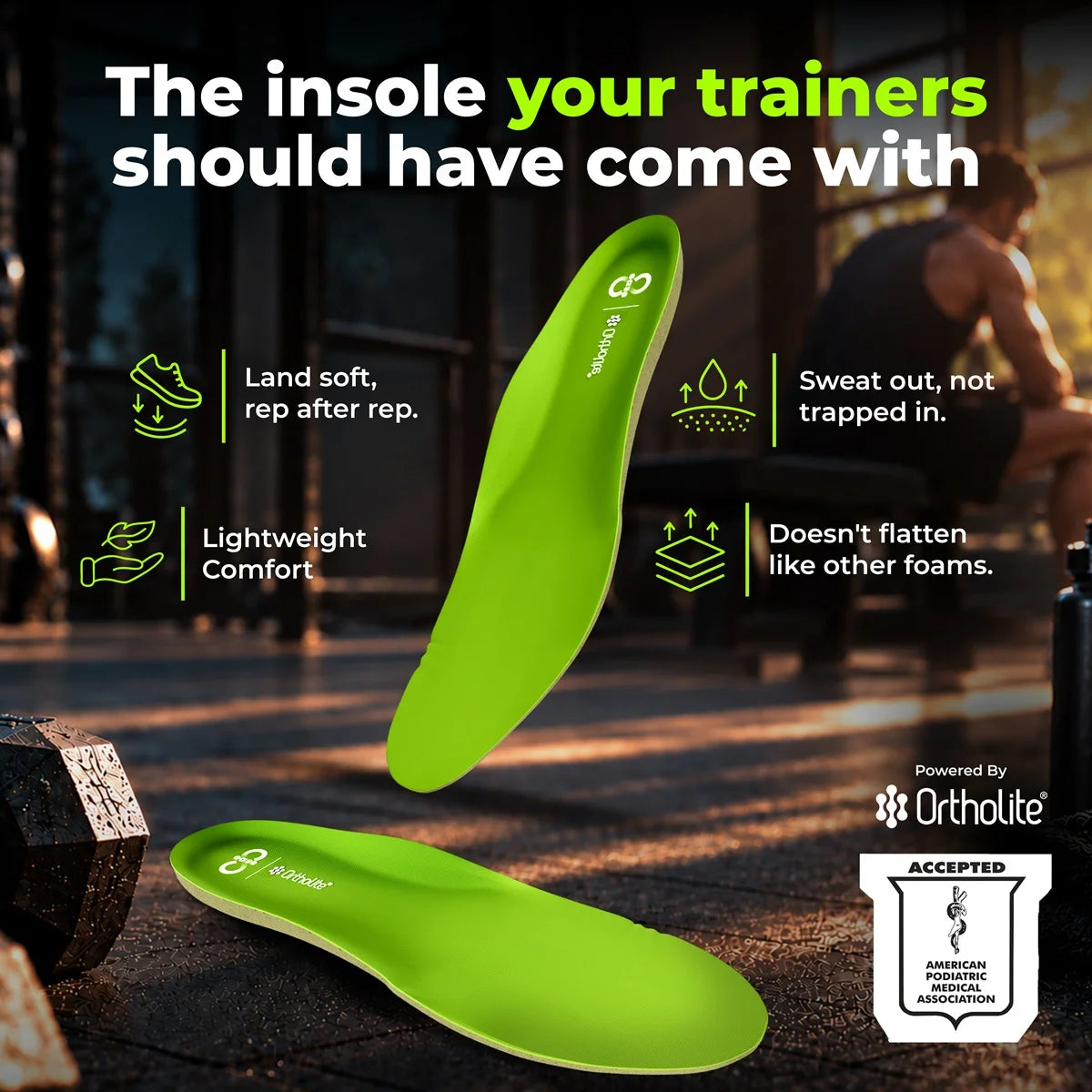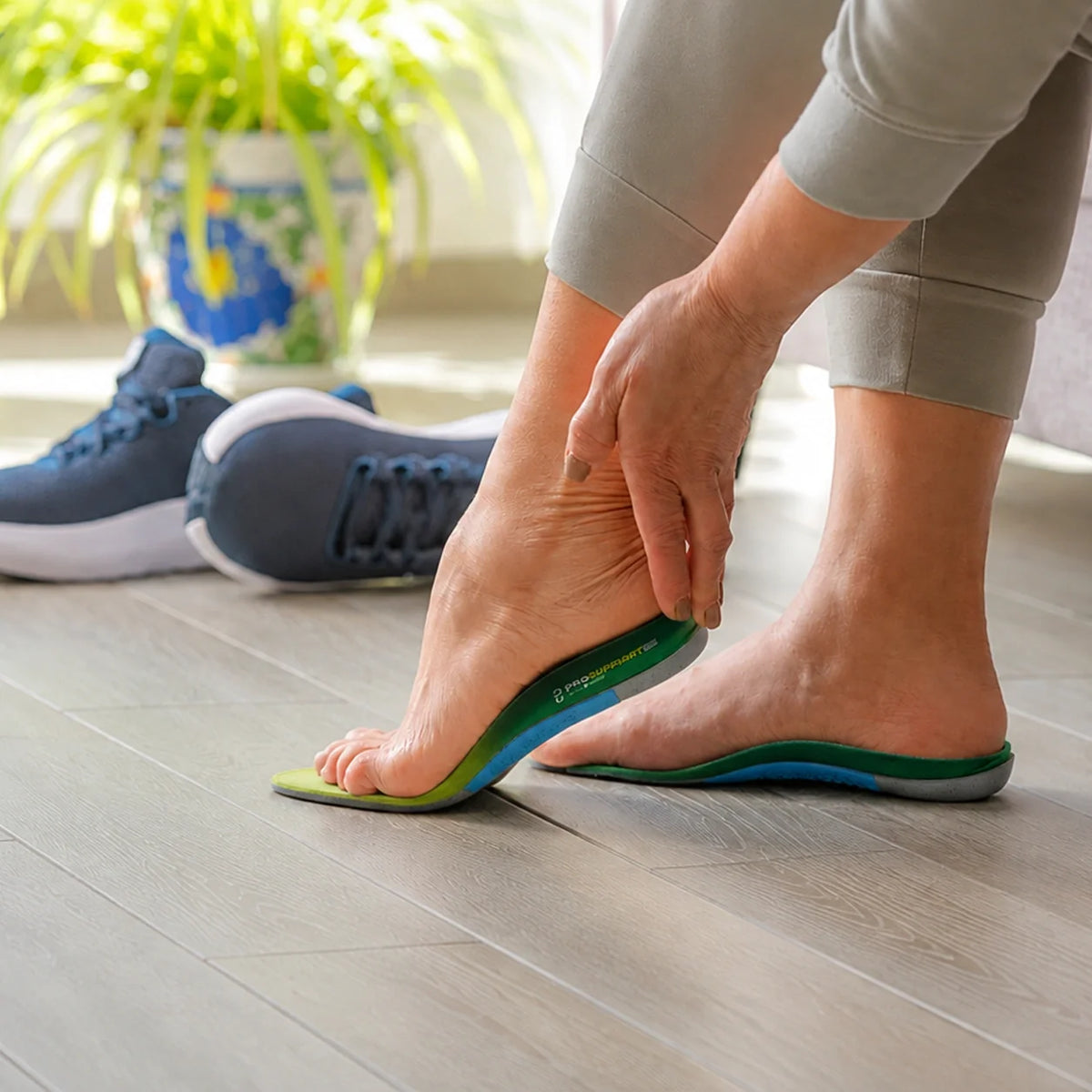

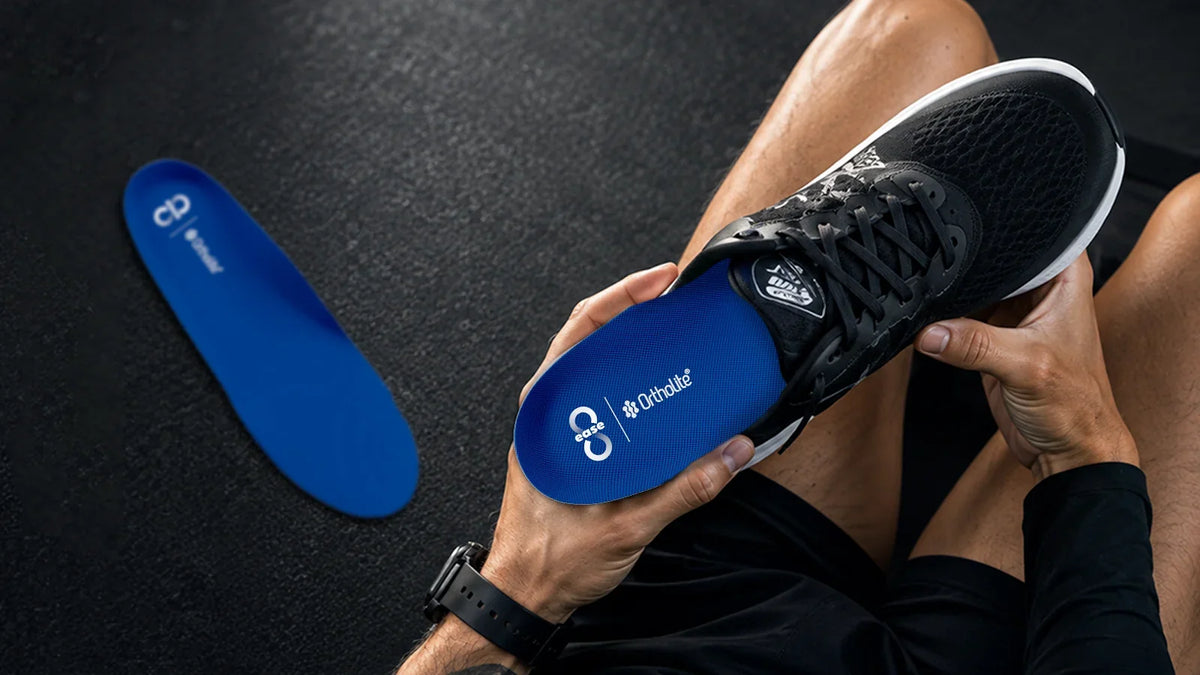
OrthoLite does not sell insoles directly to shoppers in India. It makes the foam inside the shoes of more than 550 brands. To buy a standalone pair here, you buy from a brand that co-brands with OrthoLite. Every 8ease insole is made in collaboration with OrthoLite® and carries both names, from ₹299 for an everyday pair to ₹1,499 for sport and heel-pain insoles.
You bought a good pair of running shoes or office sneakers. The insole inside said OrthoLite®, and for the first few months your feet felt the difference.
Then a year of Indian roads happened. Tiled office floors, a hot metro platform, a monsoon or two. The insole went flat, started to smell, and now the shoe feels like a different shoe.
So you search for a replacement and hit a wall. The shoe brand doesn't sell the liner on its own, the "OrthoLite" listings online look doubtful, and nobody explains whether you even need the same thing again.
This guide answers all of it: what OrthoLite actually is, where to buy it in India, which replacement suits your shoe and your feet, how it compares with memory foam and EVA, and how to wash it and make it last.
What is OrthoLite®, in plain words?
OrthoLite is a specialised open-cell PU foam used as the cushioning layer in insoles. It is not a shoe brand and it is not a medical orthotic. It is the material your foot rests on.
The company was founded in 1997 by Glenn Barrett and is based in Amherst, Massachusetts. Today it supplies more than 550 footwear brands and makes insoles for over 500 million pairs of shoes a year. In India it runs an expanded plant in Ambur, Tamil Nadu, with capacity of two million pairs of insoles a month, and 66 of its brand partners make shoes here.
What makes the foam different, in OrthoLite's own published figures:
- Open cells that breathe: the foam is 95 to 100% breathable, so air moves in and around it and moisture is carried away from the foot. In our heat and humidity, this is the feature you feel most.
- Cushioning that holds its shape: OrthoLite states its foam compresses less than 5% over the life of the product. Ordinary foams pack down and stay down.
- Built-in odour resistance: an antimicrobial treatment is cross-linked into the foam itself, not sprayed on top, to resist fungus, bacteria and odour.
- Washable: the foam is machine washable on a gentle cycle and comes back to shape after air drying.
- Lighter on the planet: OrthoLite foams contain recycled rubber or reused production foam, from 5% upwards.
Think of the factory liner in a basic shoe as a thin pillow that goes flat in a week. OrthoLite is closer to a good mattress topper: it gives under you, then springs back, night after night.

"Ortho" doesn't mean orthopedic
Because of the name, many people assume OrthoLite is a medical orthotic. It isn't. OrthoLite is the cushion. Arch support, heel control and structure come from the shape of the insole and any shell built into it.
That is why a factory OrthoLite liner, which is usually flat, feels lovely but does little for flat feet or heel pain. It is also why every 8ease insole pairs the OrthoLite foam with a shape designed for a specific foot or a specific day.
Where can you buy original OrthoLite insoles in India?
Not from OrthoLite directly. OrthoLite's own branded insoles are sold through its Amazon store in the United States. In India, you get OrthoLite foam in two ways: inside a new pair of shoes, or in a standalone insole from a brand that co-brands with OrthoLite.
8ease is that brand. Every 8ease insole is made in collaboration with OrthoLite® and carries both names on the insole and on the box. They are sold on 8ease.in and on Amazon India, and the adult insoles also carry the APMA Seal of Acceptance from the American Podiatric Medical Association.
How to tell if an "OrthoLite" insole is genuine
- The name is printed on the product. Genuine OrthoLite foam carries the OrthoLite name on the insole or its packaging, usually next to the partner brand's name.
- There is a brand behind it. OrthoLite works through licensed partner brands. An unbranded listing that says "OrthoLite type", "like OrthoLite" or "Ortho foam" is a different foam.
- The price makes sense. A full-length insole in open-cell foam with a moulded heel cup does not cost ₹99. If it does, it isn't the same material.
What do OrthoLite insoles cost in India?
Shoe brands rarely sell their liners separately, so the realistic options are co-branded insoles. Here is the full 8ease range, all OrthoLite foam, so you can see what each price buys:
| Insole | What it adds to the OrthoLite foam | Best for | Price |
|---|---|---|---|
| Basics Revive | Flat-cut cushioning, no moulded arch | A first insole, a direct liner swap | ₹299 |
| Daily Relief Arch Insole | Soft moulded arch, deep heel cup | Office shoes, sneakers, long hours standing | ₹549 |
| Sports Support Insole | Contoured arch, cupped heel, anti-slip base | Running, gym, football | ₹649 |
| ProSupport Low, Medium, High Arch | Semi-rigid arch shell at 7, 12 or 17 mm | Flat feet, aching arches, high arches | ₹849 |
| Sprouts | Soft arch, deep heel cup, kids' sizes | School shoes, ages about 2 to 8 | ₹799 |
| Belle SoleComfort | Ultra-thin cushioning | Flats, ballerinas, juttis | ₹799 |
| Plantar Specialist | 25 mm arch on a TPU shell, reinforced heel cup | Heel pain, plantar fasciitis | ₹1,499 |
| Racket Pro | Forefoot cushion zone, TPU lateral shell | Badminton, tennis, pickleball | ₹1,499 |
| Cricket Pro | 25 mm TPU shell, metatarsal pads, water-resistant | Spikes and studded cricket shoes | ₹1,499 |
If your budget for a replacement is under ₹1,500, every one of these fits it. Free delivery above ₹599.
My shoes came with OrthoLite insoles. What do I replace them with?
Match the replacement to the shoe and to your feet, not just to the foam. The foam is the same across the range. What changes is the shape, and that is what decides whether the shoe feels right again.
Brands such as Adidas, ASICS, Skechers and Timberland use OrthoLite in many models. In India, Bata launched its Power Move+ range in 2025 with an OrthoLite in-sock in at least one model. Not every comfort foam is OrthoLite, though: PUMA's SoftFoam+ is PUMA's own sockliner, and Clarks' Cushion Plus is Clarks' own cushioning, even though Clarks uses OrthoLite separately in some shoes. The quickest check is the liner itself: if it's OrthoLite, the name is printed on it.
| Your shoe | What usually came in it | The 8ease replacement | Why |
|---|---|---|---|
| ASICS, Adidas or other running shoes | Flat OrthoLite sockliner | Sports Support Insole | Same rebound feel, plus an arch and cupped heel for landing |
| Running shoes, and you have flat feet | Flat sockliner | ProSupport Low Arch | A 7 mm shell for the inward roll a flat liner can't stop |
| Bata Power or everyday sneakers | Thin foam or OrthoLite in-sock | Daily Relief Arch Insole or Basics Revive | Soft arch for long days, or a straight liner swap |
| Leather boots (Woodland and similar) | Thick foam footbed | ProSupport at your arch height or Daily Relief | Boots have room for a structured insole; choose the arch by the wet test, or Daily Relief if they're snug |
| Clarks and other formal shoes | Slim cushioned footbed | Daily Relief Arch Insole | Slim enough for a formal shoe |
| Yonex, Victor, Li-Ning or ASICS court shoes | Thin flat liner | Racket Pro | Built for lunges and sideways pushes |
| Cricket spikes | Thin liner | Cricket Pro | Deep heel cup for the landing foot, washes off red soil |
| Your child's school shoes | Thin card or foam | 8ease Sprouts | Kids' sizes, soft arch, no rigid shell. See how to choose school shoes |
| Flats and juttis | Often nothing removable | Belle SoleComfort | Ultra-thin, trims to the shoe |

Will a trim-to-fit insole squeeze my toe box?
Not if you take the old liner out first. A replacement insole should take the place of the factory liner, never sit on top of it. Stacking two lifts your foot into the toe box and makes the shoe tight across the top.
Say you wear UK 9 leather boots. Lift the old liner out, lay it on the new insole with the heels lined up, trace the toe, and cut a little outside the line. A UK 9 is size M in every sized 8ease adult insole. If the boot was already snug, choose the slimmer Daily Relief over a structured ProSupport. The size guide has every band and the trimming steps.
Can I swap my badminton shoe's liner for a thicker sports insert?
Yes, as long as you replace, not add. Court shoes are built low to the ground for quick changes of direction, so a thick running insole raises your foot and makes you less stable on lunges. The Racket Pro is slim for exactly this reason, with a TPU lateral shell that resists the roll on sideways pushes. Our sports insoles guide goes sport by sport.
OrthoLite vs memory foam vs EVA: which is better?
For Indian heat and daily wear, open-cell OrthoLite foam beats memory foam on breathability and beats EVA on how long it keeps its cushion. Memory foam feels softest in the shop; EVA is the cheapest and lightest. Here is how they compare where it matters.
| Material | How it feels | In humid weather | After months of use | Choose it if |
|---|---|---|---|---|
| OrthoLite® open-cell PU | Soft, springs back quickly | Breathable, carries sweat away | OrthoLite states under 5% compression over its life | You wear the shoe daily, in heat, for years. Every 8ease insole uses it |
| Memory foam | Very soft, sinks and slowly recovers | Dense, traps heat, feet can feel hot and damp | Softens further; can feel bottomed out | You want the softest step-in feel and your feet stay cool |
| EVA | Firm, light, springy at first | Closed cells, little airflow | Tends to pack down and stay compressed | You want the lightest, cheapest option and accept a shorter life |
| Generic PU foam | Varies widely | Depends on the formulation | Depends on the formulation | You know the brand and its foam; OrthoLite is itself a PU foam |
The memory foam, EVA and generic PU rows describe how those materials generally behave; individual products vary.
Memory foam vs OrthoLite for sweaty feet
If your memory foam insoles feel hot by lunchtime, it isn't your imagination. Memory foam is dense and slow to recover, so heat and moisture sit against the foot. Open-cell foam lets air move through it. For a Mumbai summer or a Bengaluru monsoon, switching to an OrthoLite insole is one of the simplest ways to keep feet drier, and the built-in antimicrobial helps with odour.
PU foam vs OrthoLite: isn't it the same thing?
OrthoLite is a PU foam, so the question is really "ordinary PU vs specialised PU". Many cheaper insoles use PU with a closed or semi-closed structure that packs down. OrthoLite's open-cell formulation is what gives it the breathability and the resistance to flattening.
I weigh 85 kg or more. Will OrthoLite hold up?
The low compression figure is exactly what matters for heavier bodies, because foam that packs down loses cushion fastest under more weight. But cushion is only half the job. If you're heavier and on your feet all day, you will also want structure underneath the foam: a ProSupport shell at your arch height spreads the load across the whole arch instead of the heel and ball of the foot.
Is OrthoLite good for flat feet and plantar fasciitis?
OrthoLite foam on its own is cushioning, not arch support. A flat OrthoLite liner will feel comfortable but won't hold up a collapsing arch or take tension off a sore heel. What helps is OrthoLite cushioning built onto the right structure.

Orthopedic insoles vs OrthoLite: what's the difference?
An orthopedic or orthotic insole is defined by its shape: an arch shell, a heel cup, sometimes a wedge, designed to change how the foot is supported. OrthoLite is a material that can go inside one. The two aren't competitors; the good insoles use both.
- Flat feet or a low arch: ProSupport Low Arch, a 7 mm semi-rigid shell under OrthoLite foam. It lifts a low arch without forcing it, and the deep heel cup helps stop the inward roll. If you just want soft support and no firm shell, the Daily Relief Arch Insole.
- A medium or high arch that aches: ProSupport Medium (12 mm) or High Arch (17 mm). Do the wet-foot test in Arch support insoles explained to find yours.
- Plantar fasciitis and sharp morning heel pain: the Plantar Specialist, with a 25 mm arch on a TPU shell and the deepest heel cup in the range, under OrthoLite foam.
If your doctor has prescribed a rigid orthotic, follow that advice. A standard flat OrthoLite liner is not a substitute for it.
Heel pain after standing 8 hours: custom orthotic, heel pad or sports insole?
It depends on the pain and the shoe:
- Sharp pain in the first steps of the morning, worse after rest: the classic plantar fasciitis pattern. Start with the Plantar Specialist. If three weeks of daily wear doesn't ease it, see a doctor; that's the point where a custom orthotic may be worth its cost.
- A sore, bruised-feeling heel by evening, in office shoes: ComfortStep Heel Pads at ₹279 cushion the heel in shoes too shallow for a full insole. They are PU foam, not gel, and they are not OrthoLite.
- General aching from long hours on hard floors: the Daily Relief Arch Insole. If you stand in one place, such as a kitchen, a counter or a standing desk, add the Circulo Active Mat underneath you.
A sports insole like the Sports Support is built for running and jumping, not for standing still, so it isn't the first choice here. The heel pain guide and the foot pain guide go deeper.
How to wash OrthoLite insoles (and get rid of the smell)
OrthoLite foam is washable: hand wash or a gentle machine cycle, then air dry. Every 8ease insole is washable, and hand washing is the gentlest option. Here is the method that keeps the shape and the cushioning.
- Take the insoles out of the shoes. Never wash them inside the shoe.
- Hand wash in lukewarm water with a little mild detergent or body wash. Scrub the top gently with a soft brush. Avoid bleach and hot water.
- Or use the machine: gentle cycle, cold or lukewarm, inside a laundry bag or pillowcase. Skip the spin if your machine allows.
- Rinse well so no soap is left in the foam.
- Press out the water by rolling the insole in a towel. Don't wring or twist it.
- Air dry flat in the shade with a fan if you have one. Not on a heater, in the dryer, or on a hot terrace in direct afternoon sun: high heat can warp the shape.
- Put them back only when fully dry. Damp foam in a closed shoe is where smell starts.
My sneakers smell after the monsoon. Can I wash the insoles with detergent and warm water?
Yes, lukewarm water and mild detergent won't harm the cushioning. Hot water is the thing to avoid. For the smell itself:
- Wash the insoles and the inside of the shoe, and dry both fully.
- Sprinkle a little baking soda (meetha soda) on the dry insoles overnight, then tap it off.
- Keep a second pair in the monsoon and rotate, so each gets a full day to dry. If the second pair goes in different shoes, the Work + Workout Duo pairs Daily Relief and Sports Support at 5% less than buying them separately.
- Wear cotton socks and change them daily.
The antimicrobial in OrthoLite foam resists odour, but no foam can beat a shoe that never gets a chance to dry.
How long do OrthoLite insoles last?
8ease insoles are built to last two years or more in regular use, because OrthoLite foam resists packing down. How long yours last depends on how far you walk, your weight, and how often they get soaked.
Take someone who walks 10,000 steps a day on Indian roads. That's roughly 7 km a day, or more than 2,500 km a year: far more than the average shoe sees. If that's you, check your insoles every six months against these signs:
- The cushion no longer springs back when you press it with your thumb.
- The arch feels flat compared with a new pair.
- The heel cup is worn through or the top layer is peeling.
- The smell comes back soon after washing.
- Old aches return: tired arches, sore heels, or knees that feel the commute again.
Any one of these means it's time for a fresh pair. Children's insoles need replacing sooner, simply because feet grow.
Which 8ease insole is right for you?
| If this sounds like you | Start with | Price |
|---|---|---|
| My shoe's OrthoLite liner went flat, nothing hurts | Basics Revive or Daily Relief | ₹299 / ₹549 |
| Running or gym shoes need a new insole | Sports Support Insole | ₹649 |
| Flat feet or low arch | ProSupport Low Arch | ₹849 |
| Medium or high arch that aches | ProSupport Medium or High Arch | ₹849 |
| Sharp morning heel pain | Plantar Specialist | ₹1,499 |
| Badminton, tennis, pickleball | Racket Pro | ₹1,499 |
| Cricket | Cricket Pro | ₹1,499 |
| Flats or juttis | Belle SoleComfort | ₹799 |
| A child in school shoes | 8ease Sprouts | ₹799 |
Still unsure? All eleven 8ease insoles compared puts them side by side.
Small Fixes, Big Comfort: A Final Word
The OrthoLite name on your old insole was a good sign. You don't need to hunt for the exact liner your shoe came with. You need the same open-cell foam in a shape that suits your foot and your day.
And comfort doesn't stop at the shoe. Support your body wherever you are: walking, standing or sitting.
- Walking: an 8ease insole in every pair you wear often.
- Standing: the Circulo Active Mat for kitchens, counters and standing desks.
- Sitting: the Circulo Focus Seat Cushion for long hours at a desk. The Circulo range uses SP1KE™ technology rather than OrthoLite.
Free delivery above ₹599. 15-day easy returns. Ships in 5 to 7 days.
Frequently Asked Questions
Does OrthoLite sell insoles directly in India?
No. OrthoLite supplies its foam to footwear and insole brands, and its own branded insoles are sold through Amazon in the US. In India you buy OrthoLite through partner brands. Every 8ease insole is made in collaboration with OrthoLite® and carries both names.
Are 8ease insoles real OrthoLite?
Yes. All 8ease insoles are co-branded with OrthoLite® and use its open-cell PU foam, with the OrthoLite name on the insole and the box. ComfortStep heel pads, Belle stick-on pads and the Circulo range are not OrthoLite.
Is OrthoLite the same as an orthotic or orthopedic insole?
No. OrthoLite is a cushioning foam. An orthotic insole is defined by its shape: arch shell, heel cup and structure. The 8ease ProSupport and Plantar Specialist combine both.
What is the price of OrthoLite insoles in India?
Shoe brands rarely sell their liners separately. 8ease's OrthoLite insoles range from ₹299 (Basics Revive) to ₹1,499 (Plantar Specialist, Racket Pro, Cricket Pro), with most everyday pairs between ₹549 and ₹849.
Can OrthoLite insoles go in the washing machine?
Yes, on a gentle cycle in a laundry bag, with cold or lukewarm water. Then air dry flat in the shade. Never use a dryer or direct high heat.
Which is better for sweaty feet, memory foam or OrthoLite?
OrthoLite. Its open cells let air move through the foam and carry moisture away, while dense memory foam holds heat against the foot.
Is OrthoLite good for flat feet?
Only when it sits on an arch structure. A flat OrthoLite liner is comfortable but doesn't support a low arch. The ProSupport Low Arch puts OrthoLite foam on a 7 mm arch shell.
Is it normal for a new insole to feel different at first?
Yes, especially one with an arch. Wear it for a few hours a day for the first week and build up. The cushioning feels familiar straight away; the arch takes a few days.
This article is general information, not medical advice. If foot pain is severe, sudden, or does not ease with support and rest, please see a doctor or physiotherapist.
Sources: OrthoLite: features and benefits · OrthoLite features and benefits sheet, Feb 2026 · OrthoLite: about us · OrthoLite: brand partners · OrthoLite shop · Business Wire: OrthoLite India, Ambur facility · FashionNetwork: Bata Power Move+ · Clarks: Move in comfort · PUMA: SoftFoam+
Related blogs