
It's the first week of June. The uniform is ironed, the new bag is packed, and in a crowded shoe shop a salesman presses his thumb on the toe of a black school shoe and says, "Take one size bigger, madam. He'll grow into it."
You nod, because everyone says it. Your mother probably said it about your shoes too.
By August there's a red mark on the little toe, a heel that slips out with every step, and a crease where no shoe should crease.
The good news: choosing a school shoe that fits takes about ten minutes and a few tests you can do with your own hands.
What should I look for when buying school shoes for my child?
A good school shoe fits the longer foot with about a thumb's width of space at the toes, has a rounded toe box wide enough for the toes to spread, bends at the ball of the foot and not in the middle, holds the heel firmly, and fastens with velcro or laces. Brand and price matter far less than these five things.
A 2025 review of children's footwear guidelines found most advice rests on expert opinion rather than large trials, but there was clear agreement on one point: the shoe has to fit properly. So start with fit.
How do I measure my child's feet for school shoes?
Measure both feet, standing up, in the late afternoon or evening, wearing school socks. Then buy for the longer foot.
Feet swell a little through the day, which is why Ireland's HSE children's physiotherapy service says shopping later in the day gives a better fit. To measure at home:
- Tape a sheet of paper to the floor against a wall.
- Stand your child on it, heel touching the wall, full weight on the foot (not sitting).
- Mark the tip of the longest toe. In many children this is the second toe, not the big toe.
- Measure from the wall to the mark in centimetres.
- Repeat on the other foot and note the longer number.
Sizes printed inside shoes vary between brands, so go by foot length and how the shoe actually fits, not by last year's box or your child's age.
How much growth room should a school shoe have?
About a thumb's width, roughly 1 to 1.5 cm, between the tip of the longest toe and the end of the shoe. More than about 1.5 cm is not growing room. It's a shoe that is too big.
A shoe bought to "grow into" lets the heel lift with every step, so children grip with their toes to keep it on and trip more on stairs. NHS Lothian's children's footwear leaflet warns that when a shoe doesn't hold the foot, children clench their toes, which can cause painful skin, nail, muscle and joint problems. Too tight is just as bad: HealthyChildren.org says it is better to have no shoes at all than shoes that are too tight. If your child trips often even in shoes that fit, read why children walk on their toes, trip or point their feet inward.
How wide should a kid's shoe toe box be for broader Indian feet?
Wide enough that your child can wiggle all five toes, and the widest part of the foot sits at the widest part of the shoe without bulging over the sole. Choose a rounded or squarish toe box; avoid pointed or tapered fronts.
This matters more in India than most shoe-shop advice admits. Between December 2021 and March 2022, CSIR's Central Leather Research Institute (CSIR-CLRI) 3D-scanned the feet of 1,01,880 people at 79 locations. As reported by Business Today in April 2024, Indian feet tend to be wider than Western feet, and shoes built on Western size systems often fit poorly, especially for children and teenagers.
That work led to a proposed Indian sizing system called 'Bha' (from Bharat). It was still a proposal when reported, so the width check is up to you for now.
The insert trick: pull the factory insert out of the shoe and stand your child on it. If the toes or the outside edge of the foot spill over the sides, the shoe is too narrow, whatever the size label says.
Are stiff school shoes with flat soles bad for children's feet?
It depends where the stiffness is. A good shoe is firm at the heel and through the middle, but bends easily at the ball of the foot. A shoe that won't bend at the toes at all, or one that folds in half in the middle, is the problem.
The American Podiatric Medical Association (APMA) suggests a quick three-part test: squeeze the heel counter (it shouldn't collapse), bend the shoe (it should flex where the toes bend), and twist it like a towel (the middle should resist). All three are in the checklist below.
What about closed shoes in general? A survey of 2,300 Indian children aged 4 to 13, published in 1992 by Rao and Joseph, found flat feet in 8.6% of children who wore footwear compared with 2.8% of those who did not, and most often in children who wore closed shoes. That's an association, not proof that shoes cause flat feet.
Your child still has to wear a closed school shoe. So choose one that fits and bends well, and balance the school day with barefoot time at home. More on that in barefoot or shoes: what grass, sand and barefoot shoes do for your child's feet.
Which shoes are best for flat feet in school-going children?
There is no special school shoe that builds an arch. For most children with flexible flat feet, the best choice is simply a well-fitting shoe with a firm heel counter and a sole that bends at the toes. If your child has tired or achy feet, a soft supportive insole can make the day more comfortable.
In a 1989 study by Wenger and colleagues, 129 children with flexible flat feet were randomly given corrective shoes, a heel cup, a custom moulded insert, or nothing. After three years, arches had improved in every group, including the children given nothing, with no difference between groups.
OrthoInfo, from the American Academy of Orthopaedic Surgeons, says flexible flat feet without pain need no treatment, and that where there is aching or tiredness, ready-made arch supports may help and are usually as useful as custom ones.
So skip expensive "special" shoes unless a doctor has asked for them. Unsure whether your child's flat feet are normal for their age? Start with flat feet in children: what's normal at each age.
Why does the factory insole in school shoes matter?
Most school shoes come with a thin, flat insert of basic foam that presses down within weeks, leaving very little between your child's heel and a tiled or stone floor. Swapping it is the cheapest upgrade you can make to a shoe that already fits.
Pull one out after a couple of months and you'll often see a footprint pressed into it, like a thin bedsheet on a marble floor. Now add six to eight hours of assembly on concrete, tiled corridors, the PE period, and cricket in the lane before tuition.
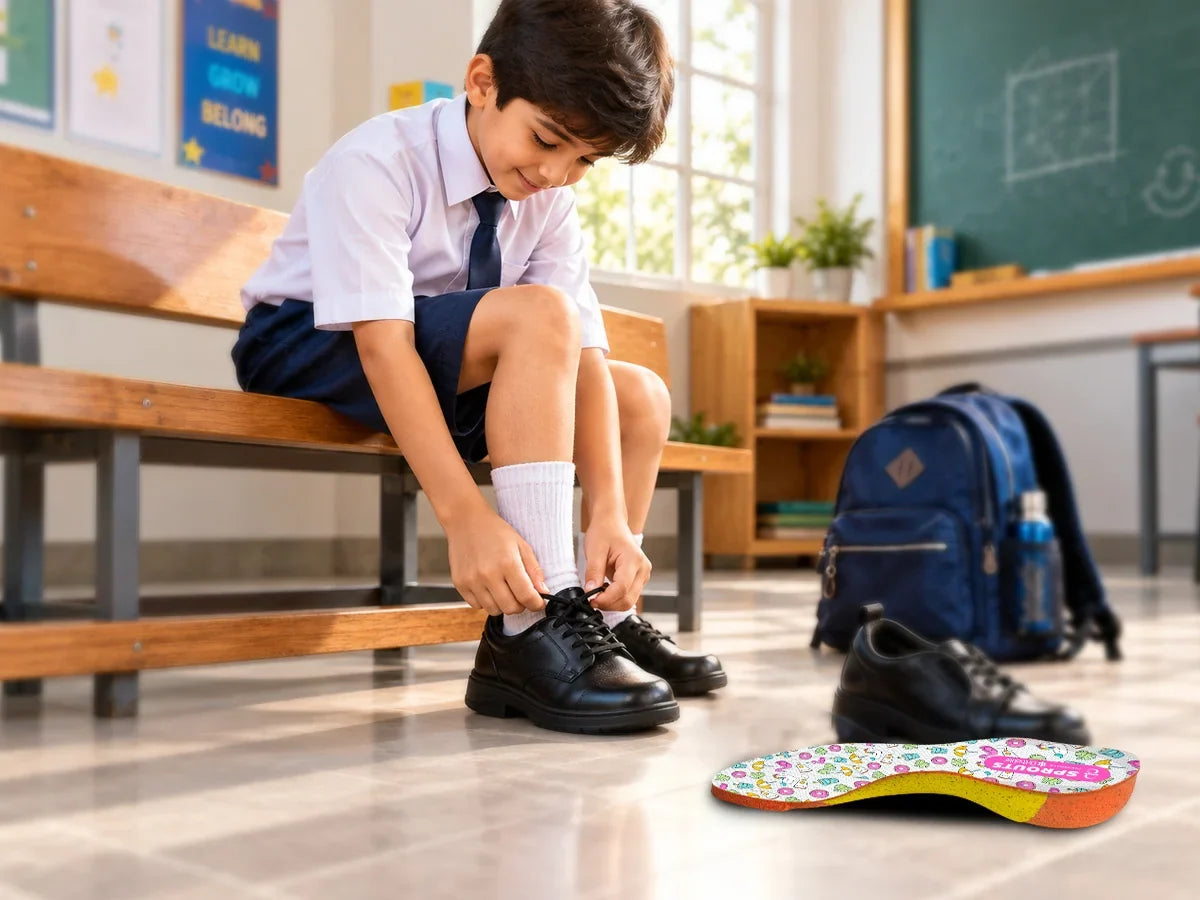
For children up to Youth UK 1 (roughly playschool to about class 2), 8ease Sprouts kids insoles replace that flat insert with a soft, flexible arch and a deep heel cup, with no rigid plastic shell. The OrthoLite® open-cell foam springs back instead of flattening, and the antimicrobial top cover helps with sweaty feet in June heat.
To be honest about what it does: Sprouts supports and cushions while it's worn. It does not shape or build the arch, and a child who runs around happily with no aches may need nothing more than a well-fitting shoe.

Go by the UK size on the school-shoe box or by foot length, not by age. Many Indian children reach a size later than the charts say.
| Sprouts size | UK child size | EU | Foot length | Roughly ages |
|---|---|---|---|---|
| S | Kids 6 to 8 | 23 to 25.5 | 14.5 to 16 cm | 2 to 3 |
| M | Kids 9 to 11 | 27 to 29 | 17 to 18 cm | 3 to 5 |
| L | Youth 12 to 1 | 30.5 to 33 | 19 to 20.5 cm | 5 to 8 |
Children bigger than Youth UK 1 have outgrown Sprouts. From UK 4, our adult insoles in size S (UK 4 to 7) fit, such as the Sports Support Insole for children who play a lot of sport. We don't make a size for UK 2 yet.
Shop tip: take the insole with you and try the new shoe with it inside. Remove the factory insert first and never stack the two. Also check that the factory insert lifts out; some cheaper shoes glue it in.
Velcro or laces: which is better for school?
Either works, as long as it holds the heel snugly. Velcro suits younger children who can't tie laces yet; laces give a closer fit for older ones. Avoid slip-ons, which make children grip with their toes.
Two more checks for Indian weather. Weight: a school shoe should feel light in your hand, not like a brick. Breathability: look for a lining that breathes, and in the monsoon, take the insert out at night so everything dries.
What's the in-shop checklist for school shoes?
Run through these checks before you pay. It takes less time than the billing queue.
| Check | How | Pass / fail sign |
|---|---|---|
| Length | Child stands; press at the tip of the longest toe | Pass: a thumb's width (1 to 1.5 cm). Fail: toe touching, or much more than 1.5 cm |
| Width and toe box | Stand child on the pulled-out insert; ask them to wiggle toes | Pass: foot within the edges, rounded front. Fail: toes spill over or press together |
| Bend point | Hold the heel, push the toe up | Pass: bends at the ball of the foot. Fail: bends in the middle, or won't bend |
| Twist | Wring the shoe gently | Pass: firm through the middle. Fail: twists easily |
| Heel counter | Squeeze the back of the shoe | Pass: holds its shape. Fail: collapses flat |
| Heel hold | Child walks around the shop | Pass: heel stays in place. Fail: heel lifts out |
| Fastening | Do up the velcro or laces | Pass: snug and adjustable. Fail: slip-on |
| Insert | Try to lift it out | Pass: removable. Fail: glued in |
| Comfort | Five minutes of walking | Pass: comfortable now (the APMA says no breaking-in). Fail: "it will soften" |
What mistakes should I avoid?
- Buying well over a thumb's width big, buying by age or last year's box size, or shopping in the morning.
- Hand-me-down shoes. A worn shoe has moulded to another child's foot, and the APMA advises never handing down footwear, partly because shared shoes can spread fungal infections.
- Ignoring shoes that wear down on the inside edge. That pattern often goes with ankles that roll inward. Here is what ankles rolling in means for your child.
How often should I check my child's school shoe size?
Every three to four months, and more often for younger children. Island Health's children's footwear guide suggests inspecting shoes every three months; for toddlers, HealthyChildren.org suggests about once a month.
School reopening (March to June) is the obvious time, but a quick check around the Diwali break is just as useful. Signs it's time: red marks on the toes or heel, socks wearing through at the toe, the upper bulging over the sole, or shoes kicked off the moment your child is home.
Which 8ease is right for your child?
| If this sounds like your child | Start with | Price |
|---|---|---|
| Shoes fit well, no aches, runs and plays happily | Nothing. A well-fitting shoe and barefoot play at home | Free |
| Up to Youth UK 1 (roughly 2 to 8 years), tired feet after long school days, flat factory insert | Sprouts kids insoles | ₹799 |
| UK 3 to 6, wants a little extra heel cushion on hard school floors | ComfortStep Heel Pads, size S | ₹279 |
| UK 4 to 7, sporty, PE and cricket most days | Sports Support Insole, size S | ₹649 |
| UK 4 to 7, everyday school wear | Daily Relief Arch Insole, size S | ₹549 |
Free delivery above ₹599. Cash on delivery available. 15-day easy returns.
Not sure of the size? Our insole size guide has the full kids chart.
When to see a doctor
- Foot or heel pain that keeps coming back, or stops your child playing
- Pain, a limp or swelling on one side only
- A foot that looks flat even when your child stands on tiptoe or sits down
- A stiff foot, or an ankle that won't move freely
- Blisters, sores or ingrown toenails that keep returning despite well-fitting shoes
Frequently asked questions
How much bigger should I buy my child's school shoes?
About a thumb's width, roughly 1 to 1.5 cm, beyond the longest toe when your child is standing. Anything more than that and the heel will slip, which causes rubbing and tripping.
My child has flat feet. Do they need special school shoes?
Usually not. In studies of children with flexible flat feet, corrective shoes and inserts did not change how the arch developed. A well-fitting regular shoe is enough for most. If there are aches or pain, see a paediatrician.
Is it okay to use an elder sibling's school shoes?
It's better not to. Worn shoes take on the shape of the first child's foot, and foot doctors advise against handing them down. A younger sibling deserves a shoe shaped by nobody.
My child is in UK 2. Which 8ease insole fits?
We don't make a size for UK 2 yet. Sprouts goes up to Youth UK 1, and our adult insoles start at size S (UK 4). For now, focus on a well-fitting shoe with a firm heel.
How long do kids' insoles last?
With daily school wear, plan on replacing a kids' insole about every six months, or sooner when your child moves up a shoe size. One pair can move between the school shoe and the sports shoe.
This article is general information, not medical advice. If your child has pain that is severe, getting worse, only on one side, or stops them playing, please see a paediatrician.
Related reading
- Flat feet in children: what's normal at each age, and when to see a doctor
- Do kids need arch support insoles? An honest answer for Indian parents
- Barefoot or shoes? What grass, sand and barefoot shoes do for your child's feet
- Ankles rolling in and shoes worn on the inside edge: what it means for your child
- Why does my child walk on toes, trip often or point their feet inward?
- Insoles for Indian feet