

Type "insoles for Indian feet" into Google and you will find a lot of brands claiming it and very little explanation of what it means. It is not a marketing line. Indian feet are measurably different from the foot shape that most shoes, and most insoles, are designed around, and the difference shows up exactly where an insole is supposed to help: the width across the ball of the foot, the width of the heel, and where the arch sits.
This guide sets out what the measurements actually say, why an insole cut to a European or American template fits badly in a shoe that already fits badly, and how to pick one that was built for the foot you have.
What is different about Indian feet
Three things, and all three have been measured rather than assumed.
The forefoot and heel are wider. A 2024 pilot study at the Footwear Design and Development Institute (FDDI) built a new shoe last for Indian men by 3D-scanning feet and comparing them with the standard European size 42 last that most casual shoes are cut from. Foot width, heel width, ball girth and instep girth all needed significantly higher values before the last fitted Indian feet. The authors describe Indian feet as having wider forefeet and shorter toe lengths than the template assumed.
The proportions are different, not just the size. A separate FDDI scan of 117 adults found a mean foot length of about 249 mm against a forefoot width of about 92 mm and an arch height of about 15 mm. The width-to-length relationship is what a standard last gets wrong: a shoe that is the right length is often still too narrow across the ball of the foot.
Flat and low arches are common. A study of 500 young adults in Gujarat found flexible flat foot in 13.6% of them, measured by the navicular drop test. That is one in seven, before counting the many more people whose arches are low rather than flat, or have dropped with age and weight.
Then there is the way we live on them. Most of us are barefoot or in chappals at home, on tile, marble or concrete, for a large part of every day. Feet that spend hours flat on a hard floor spread wider and lose arch support, which is why so many adults in India have feet that are broader and flatter than the shoe they are trying to buy.

Why an imported insole fits badly
An insole is only useful if it sits in the right place under the foot. An insole cut to a Western template goes wrong in three predictable ways inside an Indian shoe.
It is too narrow at the forefoot. The insole ends before the ball of the foot does, so the outer edge of the foot hangs over the side or the insole curls up against the shoe wall. Either way the cushioning is not under the part of the foot that needs it.
The arch is in the wrong place. On a foot with a shorter toe length and a wider forefoot, the arch of the foot sits further back relative to the overall length than the template expects. A moulded arch built for a longer, narrower foot ends up pressing into the front of the arch instead of supporting the middle of it. That is the "lump under my foot" feeling people complain about with imported arch supports.
The arch is the wrong height. Many imported insoles assume a medium arch and offer one height. On a flat or low arch that feels like standing on a golf ball; on a high arch it does nothing. Height has to be a choice, not a given.
The fix is not a magic insole. It is three design decisions: cut the insole wider and let you trim it to the shoe, offer the arch in more than one height, and make the material survive hard floors. That is how the 8ease range is built.
How 8ease insoles are built around it

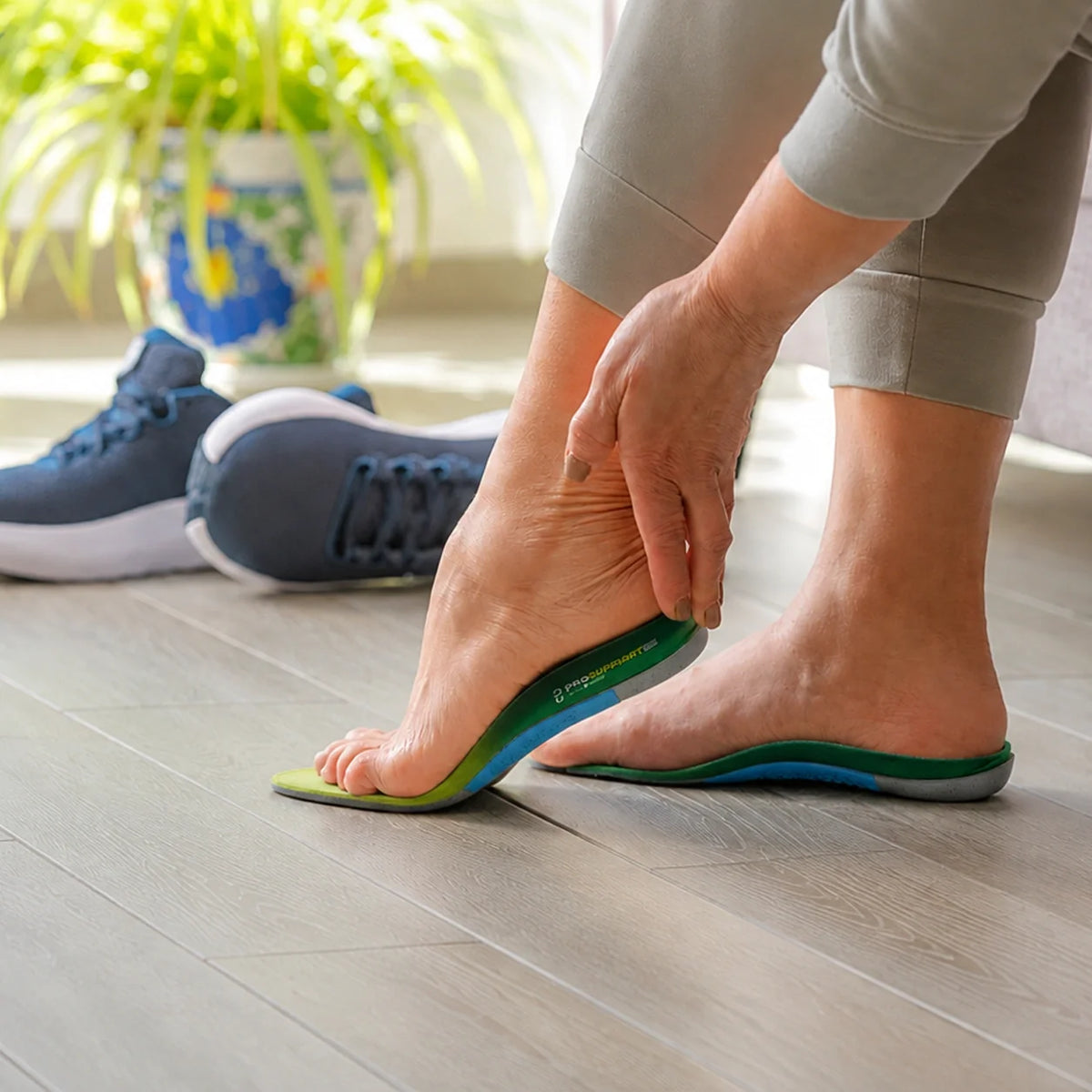
Cut wide, trimmed to fit. Every 8ease insole comes slightly oversized with trim lines printed on the underside. You take the shoe's original liner out, lay it on the insole, and cut to that outline. A wide forefoot gets its full width; a narrow court shoe gets a narrow insole. The same pair fits a formal shoe and a sneaker.
Three arch heights, not one. The ProSupport range comes as Low Arch (7 mm) for flat and low arches, Medium Arch (12 mm) and High Arch (17 mm), at the same price, so the choice is purely about the shape of your foot. For everyday comfort without a structured shell, the Daily Relief Arch Insole has a soft moulded arch that suits most normal arches.
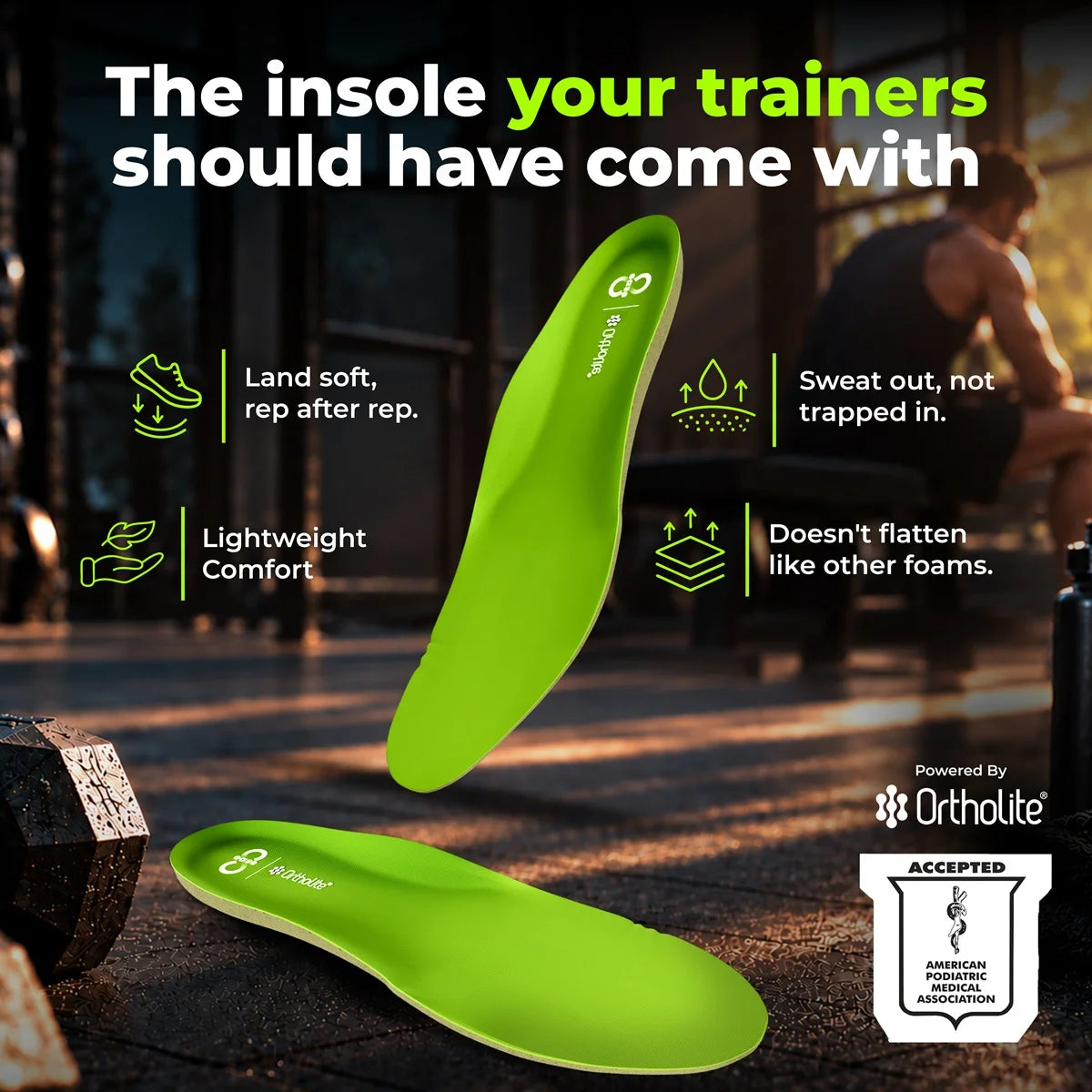
Made for hard floors. Every insole uses OrthoLite® open-cell PU foam, the same material used by 500+ global footwear brands. It compresses and springs back with each step instead of flattening, breathes in our heat, and is machine washable, which matters in a monsoon. It is made in India.
Sized in UK bands with real children's sizes. Adult insoles come in UK size bands and Sprouts for children comes in Kids 6 to 8, Kids 9 to 11 and Youth 12 to 1, so a school shoe gets a child's insole rather than a cut-down adult one.
Find your arch in two minutes
Wet your foot and step onto a dry tile or a sheet of paper.

Almost the whole foot shows: low or flat arch, start with the Low Arch (7 mm). A clear curve on the inside: medium arch, the Medium Arch (12 mm) or the Daily Relief. Only the heel and ball show, with a thin strip or nothing between: high arch, the High Arch (17 mm). The full guide, with what each print means, is in Arch support insoles explained.
Three mistakes to avoid
Buying by shoe size alone. Length is the easy part. Check the width of the insole against your shoe's original liner before you trim, and if you are between sizes take the larger one and cut down.
Stacking the new insole on the old one. The factory liner comes out first. Two layers push the foot up into the toe box and make a wide foot feel even tighter.
Choosing the tallest arch because the pain is worst. Arch height is about the shape of your foot, not how much it hurts. A flat foot on a 17 mm arch will hurt more, not less.
Which 8ease is right for you?
| If this sounds like you | Start with | Price |
|---|---|---|
| Wide, flat or low-arched feet, tired by evening | ProSupport Low Arch (7 mm) | ₹849 |
| Medium arch, you want structured support | ProSupport Medium Arch (12 mm) | ₹849 |
| High arch or high instep | ProSupport High Arch (17 mm) | ₹849 |
| Normal arch, long hours on hard floors in office shoes | Daily Relief Arch Insole | ₹549 |
| A first insole, on a budget | Basics Revive | ₹299 |
| Sharp heel pain with the first step in the morning | Plantar Specialist | ₹1,499 |
| Chappals, sandals and flats with no arch at all | Belle ArchEase Cushions | ₹279 |
| A child in school shoes | 8ease Sprouts | ₹799 |
Not sure which size band you fall in? The insole size guide maps UK, EU and US shoe sizes to each 8ease size and shows how to trim.
Free delivery above ₹599. 15-day easy returns. Ships in 5 to 7 days.
Frequently asked questions
Are Indian feet really wider than European feet?
Measurably, yes. When FDDI built a last from 3D scans of Indian men and compared it with the standard European size 42 last, foot width, heel width, ball girth and instep girth all had to be increased. The difference is in proportion, not just size: a foot of the same length is wider across the ball.
Do Indian feet have flatter arches?
Flat and low arches are common. One study found flexible flat foot in 13.6% of 500 young adults, and low arches that are not quite flat are more common still. Years of barefoot time on hard floors tend to lower the arch further. It is why 8ease offers the arch in three heights rather than one.
Will an insole for Indian feet fit my imported shoes?
Yes. The insole is trimmed to the shoe's own liner, so it fits whatever shape the shoe is. The point is that it starts wide enough to cover a wide forefoot, rather than running narrow from the start.
Which 8ease insole is best for wide feet?
All of them trim to width. If the foot is wide and flat, the ProSupport Low Arch; if it is wide with a normal arch, the Daily Relief Arch Insole. The one thing to avoid is a narrow, rigid imported insole that cannot be trimmed.
Do I need a wider shoe as well?
Often, yes. An insole fixes what happens under the foot, not the width of the shoe's upper. If the sides of your feet are pressed by the shoe before any insole goes in, the shoe is the problem. Many Indian brands now cut casual shoes on wider lasts; look for a wide or "W" fitting.
What about children?
Children's feet are wide in proportion and most children have flat feet until the arch forms, usually between five and ten. Sprouts is a soft, trimmable children's insole; our flat feet guide covers when to act and when to wait.
This article is general information, not medical advice. If foot pain is severe, one-sided, or does not ease with support and rest, please see a doctor or physiotherapist.
Sources: Muralidharan V, Raj A, Kumar A, Kumar D, Pal M. Challenges in Shoe Last Design and Development of Casual Shoes for Indian Population: A Pilot Study. Emerging Trends in Industrial Machines and Mechanisms, Springer, 2026. Maity A, Jana R, Kumar SD, Ahmad R, Pal M. Anthropometric parameters of the right and left foot among Indian adults: a pilot study. Al Ameen Journal of Medical Sciences, 2024;17(4):284-293. Aenumulapalli A, Kulkarni MM, Gandotra AR. Prevalence of Flexible Flat Foot in Adults: A Cross-sectional Study. Journal of Clinical and Diagnostic Research, 2017;11(6):AC17-AC20.
Related blogs