
Sunday night, shoe-polish time. You pick up your son's black school shoes and something looks off. The left heel leans inward. The sole is worn smooth along the inside edge, while the outside still has its grip.
Then you notice it in the morning bus queue too. When he stands still, his ankles seem to sink inward and his knees almost touch.
Your mother-in-law has a theory: flat feet, and soon knock knees. A cousin swears by "corrective" shoes.
Before you buy anything, here's the calmer picture. In most children, ankles that roll in and shoes worn on the inner edge are a normal stage of growing feet. The shoes are telling you something useful, and it's usually not bad news.
What does it mean when my child's ankles roll inward?
Usually it means your child has flexible flat feet: the arch lowers when they stand, and the heel tilts slightly inward. In young children this is very common and usually painless.
Doctors call the inward roll overpronation. Some rolling in is a normal part of every step; it's how the foot absorbs impact. In children with low arches, it's simply more visible.
The Royal Children's Hospital Melbourne says having no arch when standing is normal in nearly all infants and many young children. Most develop an arch by about age 6, and about one in five never do. That's not automatically a problem; most adults with flat feet have no long-term pain.
The quick check is the tiptoe test. Ask your child to stand on tiptoe. If an arch appears and the heel tilts back towards the middle, the foot is flexible, and flexible flat feet generally need no treatment. We explain this step by step in flat feet in children: what's normal at each age.
Will my child's ankles rolling inward lead to knock knees?
There's no good evidence that rolling ankles or flat feet cause knock knees. Knock knees are a normal stage of leg growth, most common from about 3 to 6, and they usually straighten by around 7 or 8.
The usual pattern goes like this:
- Toddlers start walking with slightly bowed legs and a wide stance.
- From about 3, the legs swing the other way into a knock-kneed position. NHS Healthier Together says up to three-quarters of children aged 3 to 5 have knock knees.
- By about 7 or 8, the legs usually straighten. One NHS parent leaflet says most are in a normal position by 8 to 9.
So why do the two get blamed on each other? They show up in the same years. And when the knees angle in and the ankles sit apart, the feet can look more rolled in too.
The NHS list of causes for knock knees doesn't include flat feet. In young children, the cause is usually normal development. Rarely, it's an injury, a bone infection, arthritis, low vitamin D or an inherited joint condition such as hypermobility. Low vitamin D is worth asking your paediatrician about, since it affects growing bones.
One more honest point: an NHS leaflet on knock knees states that exercises, splints or special shoes are not recommended, and NHS Healthier Together says exercises, splints and shoe inserts have not been shown to help. Insoles don't straighten legs.
When knock knees need a check
- The gap between the ankles is more than 8 cm when the knees touch
- They're getting worse, or still obvious after about age 8
- One leg is clearly worse than the other
- Your child has pain, a limp, or knee swelling
- Your child is very short for their age
The NHS also suggests a GP check for knock knees in a child over 5. Most of these visits end with "wait and watch", but it rules out the rarer causes.
Why do my child's school shoes wear down only on the inner side?
Inner-edge wear usually means the foot rolls in as your child walks, most often because of flexible flat feet. A little wear on the outer edge of the heel is normal, because that's where the heel first lands.
The shoe can be part of the story too:
- Shoes too big: the foot slides about and the heel tips in. Common when we buy "one size up to last the year".
- Soft heel counters: cheaper school shoes often have a back that folds flat. A floppy heel counter can't hold the heel upright.
- Hand-me-downs: a worn pair has already moulded to the first child's walk. Your child inherits the tilt.
- Slipped on without undoing: squashing the back down every morning breaks the heel counter in weeks.
Wear patterns are clues, not a diagnosis. Sport also changes them; side-to-side games like badminton wear shoes differently from walking.
How do I read the wear on my child's shoes?
Look at the shoes from behind, then underneath, then inside, and compare the pair. It takes two minutes and tells you a lot.
- Put both shoes on a flat table at eye level and look from behind. Is the heel upright, or leaning in or out?
- Turn them over. Normal wear is slight on the outer edge of the heel, and slightly inside to the middle under the ball of the foot.
- Look inside. A deep dent under the big toe suggests the foot rolls in. Torn lining inside the heel suggests the heel is moving about a lot.
- Squeeze the heel counter. It should be firm. If it folds flat, it can no longer hold the heel upright.
- Compare left and right. A pair that wears evenly is reassuring. One shoe much more worn than the other is worth a doctor's look.
Here's how to read what you see:
| Wear pattern | What it usually means | What to do |
|---|---|---|
| Slight wear on the outer edge of the heel | Normal heel landing | Nothing |
| Inner edge of the heel and sole worn, heel leaning inward | Foot rolling in, usually flexible flat feet | Do the tiptoe test; choose shoes with a firm heel counter and the right size |
| Heavy wear all along the outer edge, shoe tilting outward | A higher, stiffer arch or the heel rolling out | A well-cushioned shoe; see a doctor if there's pain |
| Toe caps scuffed through | Toe walking, dragging feet, or football in school shoes | Watch how your child walks; see our guide on toe walking and tripping |
| One shoe far more worn than the other | Something different on one side | Show your paediatrician |
| Heel counter crushed flat, lining torn at the back | Shoes slipped on without undoing, or too big | Undo laces or velcro every time; check the size; replace |
For what to look for in the next pair, see how to choose school shoes for kids. If the toe caps are the problem, read why some children walk on their toes or trip often.
Can flat feet cause calf cramps or lower back pain at night?
The evidence for this is weak. Night-time leg aches in children are most often growing pains, which happen in children with every kind of foot.
The NHS describes growing pains as an aching or throbbing in both legs, mostly in the evening or at night, in children aged about 3 to 12. They're usually gone by morning.
So where does the flat-foot idea come from? A small 2003 study by Angela Evans in the Journal of the American Podiatric Medical Association looked at children with rolled-in feet and aching legs, using eight single-case experiments. In-shoe supports helped those children. The author called for more rigorous research. That's an interesting early signal, not proof.
What is reasonable: a child with flat feet who has been on their feet all day, school, then tuition, then play, may get tired feet and legs by evening. The American Academy of Orthopaedic Surgeons (OrthoInfo) mentions pain or tiredness in the feet, ankles or legs in some children with flexible flat feet, and suggests calf stretches first.
Lower back pain is different. We found no good evidence linking a child's flat feet to back pain. Physiotherapists list back pain in children under 6, and pain that wakes a child at night, as warning signs. Those need a doctor, not an insole.
Do insoles help children whose ankles roll in?
Insoles can make a child with tired, achy feet more comfortable while they wear them, but they don't change how the foot develops. If your child has no pain, they don't need one.
Two trials are worth knowing:
- A 1989 study in the Journal of Bone and Joint Surgery followed 129 children with flexible flat feet for three years. Wearing corrective shoes or inserts made no difference to how their feet developed compared with children who wore nothing.
- A 2007 trial in Foot & Ankle International gave 178 children aged 7 to 11 with rolled-in feet either custom insoles, ready-made insoles or nothing. After a year, none of the groups did significantly better, including the children who had pain.
That's why we'll never tell you an insole builds or fixes an arch. OrthoInfo's advice is that inserts are worth trying if discomfort continues, and that ready-made supports often work as well as expensive custom ones. For the full picture, read do kids need arch support insoles?
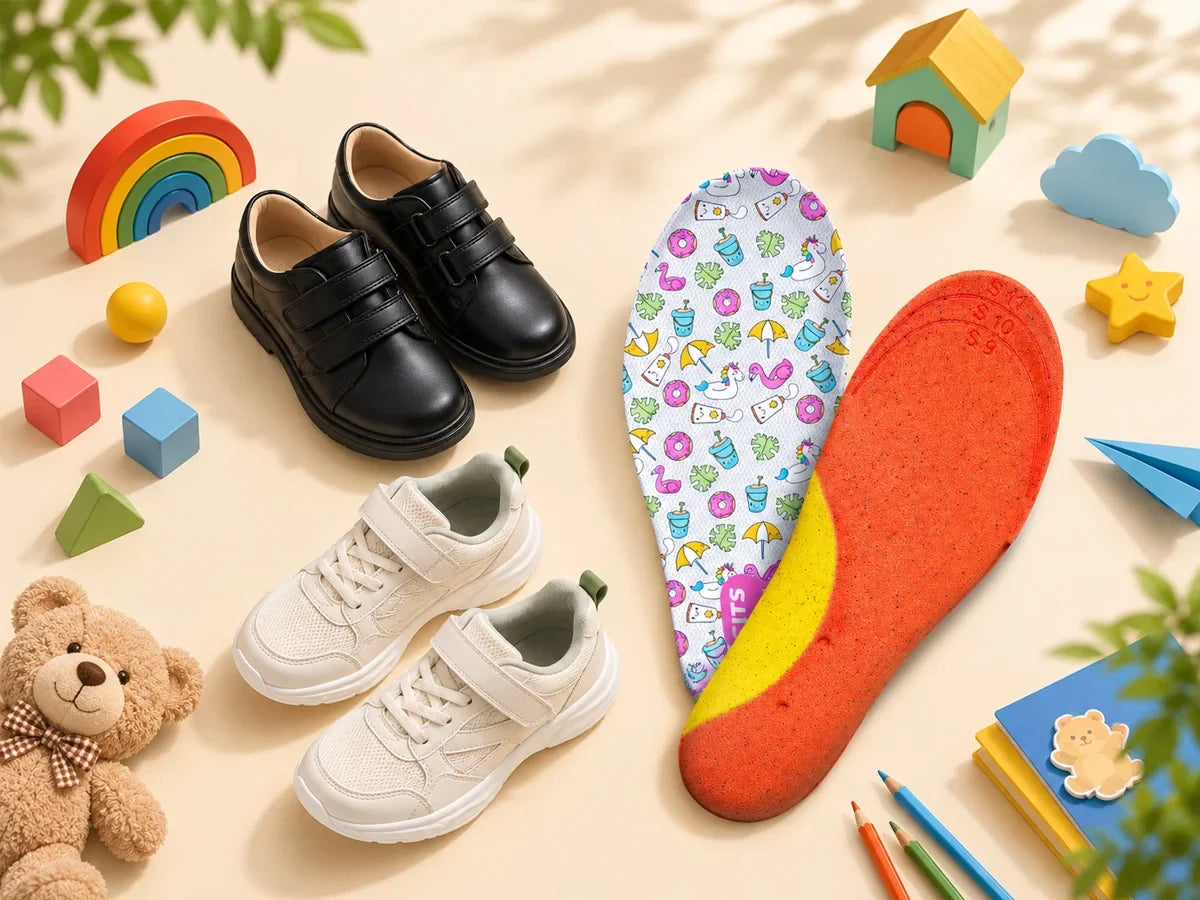
When support does make sense, for example a child with flexible flat feet who complains of tired feet after long school days in shoes that already fit well, our Sprouts kids insoles are designed for that. The deep heel cup steadies the heel, and the soft, flexible arch supports without a rigid plastic shell. They fit children up to Youth UK 1, so go by the size on the school-shoe box, not age; many Indian children reach a size later than charts say.

Older children who've outgrown Youth UK 1 can check our insole size guide; from UK 4 they fit adult insoles in size S (UK 4 to 7). The Daily Relief Arch Insole has a soft foam arch for everyday school shoes. We don't make a full insole for UK 2 or 3 yet; for those children, a shoe with a firm heel counter is the best start.
Mistakes to avoid
- Buying hard "corrective" shoes or rigid inserts for a child with no pain. The trials above found no benefit.
- Splints or exercises for knock knees without a doctor's advice. They're not recommended.
- Buying shoes two sizes up so they last the year. A sliding heel tips inward more.
- Ignoring one-sided changes. One foot, one leg or one shoe that looks different needs a check.
Which 8ease is right for your child?
| If this sounds like your child | Start with | Price |
|---|---|---|
| Ankles roll in a little, no pain, runs and plays happily | Nothing. Well-fitting shoes and barefoot play at home | Free |
| Up to Youth UK 1, tired feet after school, shoes wearing on the inside | Sprouts kids insoles | ₹799 |
| UK 2 or 3 | A shoe with a firm heel counter; we don't make a full insole in these sizes yet | No 8ease insole yet |
| UK 4 to 7, achy feet by evening | Daily Relief Arch Insole, size S | ₹549 |
| UK 4 to 7, sporty, rolls in when running | Sports Support Insole, size S | ₹649 |
Free delivery above ₹599. Cash on delivery available. 15-day easy returns.
When to see a doctor
- Foot, leg or knee pain that keeps coming back or stops play
- The foot stays flat when your child stands on tiptoe (a stiff flat foot)
- Only one foot, one leg or one shoe is affected
- Knock knees with an ankle gap over 8 cm, getting worse, or still obvious after about 8
- A limp, frequent tripping or falls
- Leg pain at night that wakes your child, or back pain in a child under 6
- Your child is very short for their age
Frequently asked questions
Is overpronation the same as flat feet?
They're closely linked. Flat feet describes the arch; overpronation describes the ankle rolling in as the foot moves. Many children with flexible flat feet overpronate, and most have no pain.
Should I buy corrective shoes for my child's ankles?
Not if your child has no pain. A three-year study found corrective shoes and inserts made no difference to how children's flat feet developed. Spend on well-fitting shoes with a firm heel counter instead.
At what age do knock knees straighten?
Usually by around 7 or 8, sometimes 9. If they're getting worse after 8, or one leg is worse than the other, see your paediatrician.
My child's new shoes are already worn on the inside after two months. Should I worry?
Not if your child has no pain and passes the tiptoe test. Check the size and the heel counter first. If one shoe is far more worn than the other, show your paediatrician.
Can my child wear hand-me-down school shoes from an older cousin?
It's better not to. A worn pair carries the first child's wear pattern and a softened heel counter, and foot doctors advise against sharing shoes.
Does my child need an insole in every pair of shoes?
No. One pair of Sprouts can move between school shoes and sports shoes. Take out the factory insole first; never stack two.
This article is general information, not medical advice. If your child has pain that is severe, getting worse, only on one side, or stops them playing, please see a paediatrician.
Related reading