
It's a Sunday evening at the society park. Your daughter is racing her cousins to the swings, and you notice it again: her feet turn in, like two little pigeons, and halfway across the grass she catches one foot on the other and goes down. She is up in a second, laughing. You are not.
Or maybe it's your son, who has walked on the balls of his feet since he was a toddler, heels never quite touching the floor. Your mother says he will grow out of it. Your neighbour says it's flat feet. A forward on the family WhatsApp group says something scarier.
Here is the reassuring part. Most in-toeing, tiptoe walking and tripping in young children is a normal stage of growing up, and it settles without treatment. A few specific signs do mean you should see a doctor, and this guide will help you tell the two apart.
Is it normal for a child to point their feet inward when walking?
Yes, in most young children it is normal. The American Academy of Orthopaedic Surgeons says in-toeing (pigeon toes) in most children under 8 resolves on its own, without casts, braces, special shoes or any other treatment.
The cause depends on where the twist sits, and that usually changes with age:
- Babies: the front of the foot curves in. This is metatarsus adductus. OrthoInfo (the AAOS patient site) says it improves by itself most of the time, usually over the first 4 to 6 months. Only stiff, severe cases need casts or special shoes, and a doctor decides that.
- Toddlers: the shin bone is twisted in. This is internal tibial torsion, noticed when a child starts walking. NHS Greater Glasgow and Clyde guidance says it normally resolves by about 4 to 5 years.
- From about 3 onwards: the thigh bone turns in at the hip. This is femoral anteversion, often most obvious around 5 or 6, and the knees may point in along with the feet. It usually improves with growth, and NHS guidance says most children have largely grown out of it by around 8 to 10.
NHS Fife adds a calming line for parents: if some in-toeing remains after 8 to 10, it has no effect on the child's future, and plenty of adults walk this way. OrthoInfo notes that in-toeing on its own does not cause pain or arthritis.
Do special shoes, insoles or exercises fix in-toeing?
No. For ordinary in-toeing, special shoes, insoles and exercises have not been shown to make a difference. The twist is usually in the shin or thigh, not the foot, so a shoe cannot reach it.
NHS Fife says there is no evidence that physiotherapy or special insoles make any difference to in-toeing going away. NHS Greater Glasgow and Clyde says special shoes or insoles make little difference because it is usually not a problem with the feet. OrthoInfo says special shoes, braces and exercises do not help femoral anteversion.
We sell insoles, and we are telling you plainly: if in-toeing is your only concern, you do not need one. Time is the treatment.
Why does my child walk on toes instead of using the whole foot?
Toe walking is common in children who are learning to walk, and most settle onto their heels by about age 2. When a healthy child keeps doing it for no clear reason, doctors call it idiopathic toe walking, which simply means "cause not known".
A Royal Berkshire NHS leaflet says between 7 and 24 out of every 100 children experience toe walking. It is more common in boys, in babies born early and where there is a family history.
The Royal Children's Hospital Melbourne describes an idiopathic toe walker as a normal child who walks on tiptoes for no known reason. These children can usually stand with their heels flat when asked; they just prefer not to. Over time some develop tight calves, which makes the habit stickier.
When is toe walking a reason to see a doctor?
See your paediatrician if your child still toe walks most of the time after age 2 or 3, does it on one side only, or cannot put their heels flat on the ground. Mayo Clinic also advises an earlier visit if you notice tight leg muscles, a stiff Achilles tendon or poor coordination.
We want to say this gently. In most children who toe walk, no cause is found and they improve over time. But persistent toe walking can sometimes be linked to:
- A short or tight Achilles tendon, the cord at the back of the heel, either from birth or tightening over time.
- Neurological or muscle conditions, which account for a smaller number of cases. OrthoInfo notes that toe walking on only one side can sometimes signal a neurological problem, which is why it deserves a check.
- Developmental differences. Children with autism-related conditions toe walk more often, but OrthoInfo is clear there is no direct link between toe walking and autism.
A doctor will watch your child walk, check the ankle and do a simple neurological check. Often the answer is calf stretches and watchful waiting. Either way, you get a real answer instead of three opinions on WhatsApp.
Why does my child limp or walk on tiptoes in the morning?
A child who limps or tiptoes first thing in the morning, or after a nap, is usually avoiding pain or stiffness somewhere, so it is worth finding out where. Common reasons include:
- Heel pain after sport. KidsHealth New Zealand says children with Sever's disease (an irritated growth plate at the back of the heel) may limp or walk on tiptoes to avoid heel pain. It mostly affects children aged about 8 to 14 and flares with running, cricket in the lane or a hard PE period. See our guide to heel pain in children.
- Irritable hip, a short-lived inflammation of the hip lining, common between about 3 and 10.
- A sprain or bruise from yesterday's game that nobody mentioned.
- Joint inflammation. Mayo Clinic notes that children with juvenile arthritis may not complain of pain, but may limp, especially first thing in the morning or after a nap. This is uncommon, and it is the reason a morning limp that keeps returning should not be ignored.
KidsHealth New Zealand advises seeing a health professional if a limp lasts more than 3 days, and getting help urgently if your child refuses to walk or put weight on a leg, has a fever, has pain that wakes them at night, or seems unwell.
My child trips and falls a lot while running. Is it flat feet or in-toeing?
Usually neither. Frequent trips are a normal part of young children learning to move, and often increase for a while during growth spurts. A Welsh NHS children's physiotherapy leaflet explains that as children grow, their limbs lengthen and their centre of gravity shifts, so they have to relearn their movement skills.
NHS Fife says in-toeing does not usually make tripping worse, although children who in-toe a lot can appear to trip more. Flexible flat feet in a child with no pain usually need nothing at all; our guide to flat feet in children explains why.
Before you look at the feet, look at the shoes. The same NHS Wales leaflet lists shoes that are too small, too big or not fastened properly as a cause of falls. In India, the classic culprit is the school shoe bought a size bigger "so it lasts the whole year". The foot slides forward, the empty toe catches on a step, and down they go. Untied laces and half-open velcro after the PE period do the rest.

Our guide to choosing school shoes shows how to check fit in under a minute: the right length, a heel that does not slip and a fastening that actually holds.
The Welsh NHS leaflet suggests a medical assessment if a child falls more than 10 times a day, gets badly hurt when they fall, or struggles to get back up. Also see a doctor if tripping is getting worse, stops your child joining in, or comes with a limp, pain or weakness.
What is normal, and when should I see a doctor?
Use this table as a quick guide, not a diagnosis. Ages are approximate and every child is different.
| What you see | Usually normal until | See a doctor if |
|---|---|---|
| Front of the foot curves in (baby) | About 4 to 6 months | It is stiff, does not straighten when gently moved, or is still clearly there after about 6 months |
| Feet point in, twist in the shin (toddler) | About 4 to 5 years | Only one side, getting worse, or with pain or a limp |
| Feet and knees point in, twist at the hip | About 8 to 10 years | Much worse on one side, getting worse, still marked after 10, pain or a limp |
| Walking on toes | About 2 years | Still most of the time after 2 to 3, one side only, or heels cannot touch the floor |
| Limp or tiptoeing in the morning | A day or two after a knock | Lasts more than 3 days, keeps returning, or comes with fever, swelling or night pain |
| Trips and falls while running | Early childhood and growth spurts | Getting worse, very frequent, stops them joining in, or with weakness or pain |
Can shoes or insoles help at all?
Shoes that fit well can cut down on trips. Insoles do not fix in-toeing or toe walking. That is the honest summary.
Get the length right, fasten them properly, and replace them when your child outgrows them rather than at the end of the school year.
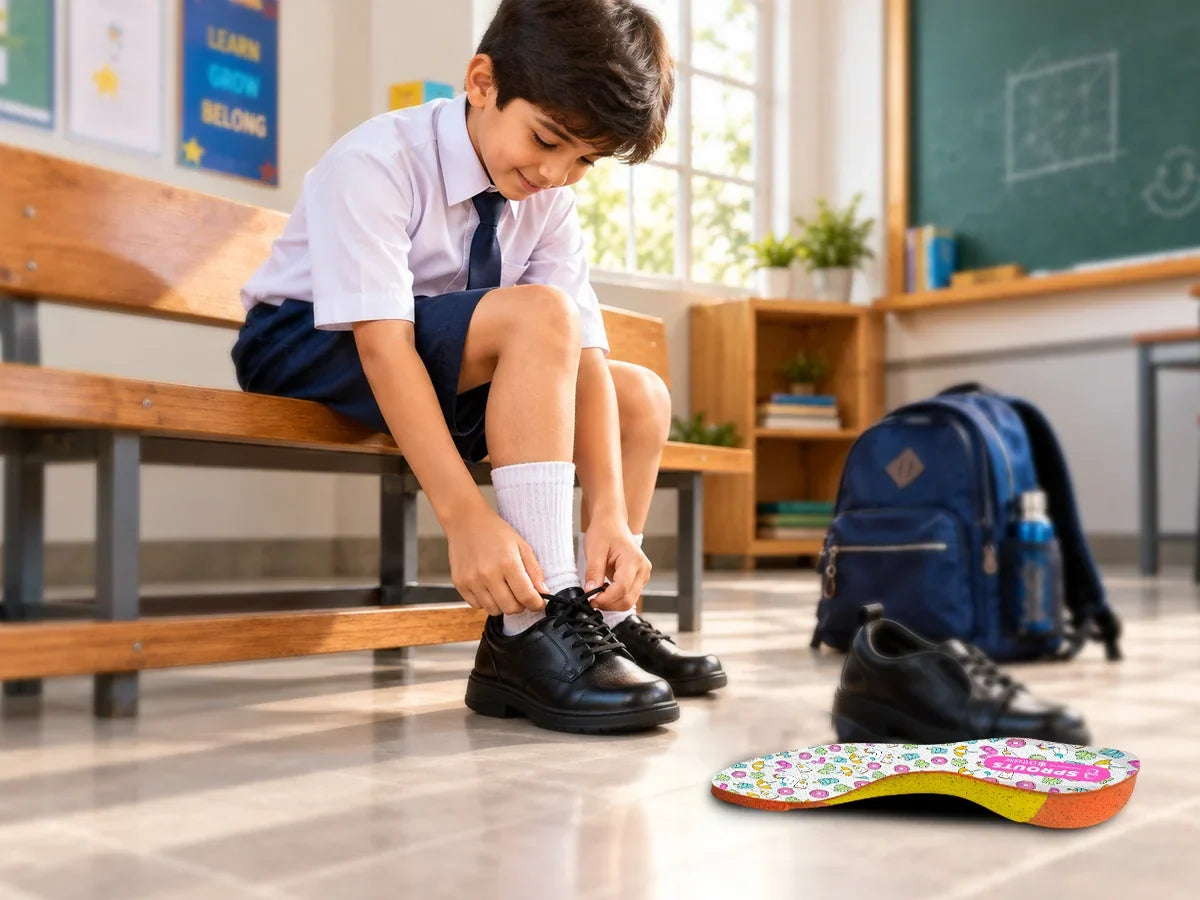
An insole helps in a different situation: a young child with flexible flat feet whose legs tire or ache by evening. There, a soft support in well-fitting shoes can make the day more comfortable. Our Sprouts kids insoles are made for this, with a soft flexible arch, a deep heel cup, OrthoLite® open-cell foam and no rigid plastic shell. They fit young children from UK kids 6 to youth 1; go by the UK size on the school-shoe box or foot length, not age, because many Indian children reach a size later than charts say. A 1989 study by Wenger and colleagues found that corrective shoes and inserts did not change how flexible flat feet developed, so think of Sprouts as comfort while worn, nothing more. Our honest answer on whether your child needs one at all is in Do kids need arch support insoles?
Which 8ease is right for your child?
| If this sounds like your child | Start with | Price |
|---|---|---|
| Toe walking after 2 to 3, on one side, heels cannot touch the floor, or in-toeing with pain or a limp | A paediatrician or paediatric orthopaedic doctor, not a product | Consultation fee |
| Feet turn in a little, no pain, runs and plays happily | Nothing. Time and barefoot play at home | Free |
| Trips a lot and the shoes are loose, oversized or never fastened | Shoes that fit, laces tied, straps done up | Free if the current pair fits |
| Flexible flat feet, up to Youth UK 1 (roughly 2 to 8), legs tired or achy by evening | Sprouts kids insoles in well-fitting shoes | ₹799 |
Free delivery above ₹599. Cash on delivery available. 15-day easy returns.
When to see a doctor
- Toe walking most of the time after age 2 to 3, or heels that cannot rest flat
- Toe walking or in-toeing on one side only
- In-toeing that is getting worse, is much worse on one side, or comes with a limp, pain or stiffness
- A limp lasting more than 3 days, or one that keeps returning in the mornings
- Refusing to walk, fever, swelling, or pain that wakes your child at night (go the same day)
- Tripping that is worsening, very frequent, or stops your child playing
Frequently asked questions
My 4-year-old's feet turn in when she runs. Will she grow out of it?
Most likely, yes. In-toeing at this age usually comes from a twist in the shin or thigh that straightens gradually, and most children have grown out of it by about 8 to 10. See a doctor if it is one-sided, worsening, or causes pain or a limp.
Should I buy special shoes or insoles for pigeon toes?
No. NHS and AAOS guidance agree that special shoes, insoles and exercises do not change ordinary in-toeing, because the twist is above the foot. Regular, well-fitting shoes are all your child needs.
My son walks on his toes at home but not in school shoes. Should I worry?
If he can stand with heels flat when asked, walks normally in shoes and has no pain, it is often just a habit. Mention it to your paediatrician if he is past 2 to 3 and does it most of the time, or only on one foot.
Is toe walking a sign of autism?
Not on its own. Children with autism-related conditions toe walk more often, but most children who toe walk are not autistic. If you have other concerns about speech, play or social development, discuss them all together with your paediatrician.
Will an insole stop my child walking on their toes?
No. Toe walking comes from habit, calf tightness or, occasionally, an underlying condition, and an insole changes none of these. If it persists, a doctor or paediatric physiotherapist can advise on stretches or other treatment.
This article is general information, not medical advice. If your child has pain that is severe, getting worse, only on one side, or stops them playing, please see a paediatrician.
Related reading
- Flat Feet in Children: What's Normal at Each Age, and When to See a Doctor
- Heel Pain in Children After Sport: Sever's Disease, Growing Pains and What Helps
- How to Choose School Shoes for Kids: Toe Box, Sole and Fit for Indian Feet
- Do Kids Need Arch Support Insoles? An Honest Answer for Indian Parents