
Have you ever noticed how often we talk about foot pain in India? An aunt complaining about her feet after a long day of shopping, a colleague who cannot stand for too long, or maybe the ache in your own arches at the end of the day.
It is so common that most of us just assume it is a normal part of getting older or being tired. But here is the truth: it is not normal, and you do not have to live with it.
A lot of this pain comes down to a simple mismatch. Our feet were not designed for the world we live in today. Our environment, from our concrete cities to our daily habits, puts a unique kind of stress on our feet. And for a very large number of Indians, the foot doing all that work is a flat one. Let's talk about what is really going on and how a simple change can make a world of difference.
The modern Indian environment vs our feet
Think about it. For centuries, people walked on softer, uneven surfaces like soil and grass. Our feet are naturally built to adapt to that. But today, the reality in places like Hyderabad, Mumbai or Delhi is completely different.
We live on hard surfaces: Most of us walk on unforgiving tile, marble or concrete floors all day long. Every single step sends a shockwave up from your foot through your body. There is no natural give, no softness to cushion the blow.
Our footwear is often unsupportive: We love our chappals, sandals and juttis. They are great for the heat, but most of them offer zero support. Even many formal shoes and sneakers come with flimsy, paper-thin insoles that flatten after a week.
We stand for hours: Whether it is a long commute on the train, a job in retail or teaching, or hours spent in the kitchen for the family, our feet are under constant pressure.

This combination of hard surfaces and poor support is the perfect recipe for foot problems. And if your arch is already low, it hits you first.
A closer look at flat feet
So, what exactly are flat feet? It is when the arch, the curved area on the inside of your foot, is very low or completely collapsed. Some people are born with low arches. Many more develop them over the years, as the ligaments that hold the arch up slowly stretch under the load of hard floors, long hours and footwear that gives them nothing to lean on.
A quick way to check is the wet test. Get your feet wet and stand on a dry surface where you can see your footprint, like a concrete step or a dark tile.

A normal arch will leave a print of your heel, the ball of your foot and your toes, with a clear curve on the inside.
A flat foot will leave a print of almost your entire foot. There is very little curve.
Why is this a big deal? Your arch acts as your foot's natural shock absorber and stabiliser. When it collapses, your foot is no longer aligned correctly. This sets off a chain reaction of problems. Your foot may roll inward, a condition called overpronation, which forces your ankle, knee and hip out of alignment. This is why people with flat feet often experience pain not just in their feet, but in their knees and lower back. Your body is trying to compensate for the lack of support, and it gets tired and sore.
If your main complaint is a sharp pain in the heel, especially with the first step in the morning, that is a related but different problem called plantar fasciitis. Flat feet are one of its most common causes. We have written about it separately in Heel pain and plantar fasciitis: which insole or heel pad helps.
What is the real solution?
Many people try temporary fixes, a soft gel pad or a quick massage, but these do not solve the underlying problem. The issue is structural. You need to support the foot's arch and cushion it from the daily shock of walking on hard surfaces.
This is where a good insole makes all the difference. But not just any insole will do. To properly tackle flat feet, you need three things:
Firm, structural arch support: Soft, squishy gel pads feel nice for a minute, but they do not provide the structure needed to hold the arch up. You need an arch support with a firm but flexible shape that lifts the arch and stops it collapsing with every step.
A deep, stabilising heel cup: The insole should cradle your heel. This helps stabilise your foot and keeps it from rolling inward, which is the movement that drags your knee and hip out of line.
Durable, shock-absorbing material: The insole material needs to be tough enough to withstand your body weight and the constant impact of hard surfaces without flattening. It should also be breathable, especially in our hot and humid climate, to keep your feet cool and dry.

Which arch height do you need?
This is the part most brands skip, and it is the part that decides whether an insole helps you or annoys you.
Arch support insoles come in different heights. The right one is chosen by the shape of your foot, not by how much it hurts. A taller arch is not a stronger insole. It is a different shape for a different foot, and a flat foot pushed onto a high arch feels like standing on a golf ball.
| Your wet test print | Your arch type | What you need | 8ease product | Price |
|---|---|---|---|---|
| Almost the whole foot shows, very little curve | Flat or low arch | A 7 mm structured arch that lifts without forcing | ProSupport Low Arch (7 mm) | ₹849 |
| A clear curve on the inside, about half the midfoot showing | Medium arch | A 12 mm arch for general structured support | ProSupport Medium Arch (12 mm) | ₹849 |
| Only the heel and ball of the foot show, a thin strip or nothing in between | High arch | A 17 mm arch that fills the gap under the midfoot | ProSupport High Arch (17 mm) | ₹849 |
| Your print looks normal but your feet are tired at the end of the day | Everyday fatigue, not a flat foot | Everyday arch support and cushioning | Daily Relief Arch Insole | ₹549 |
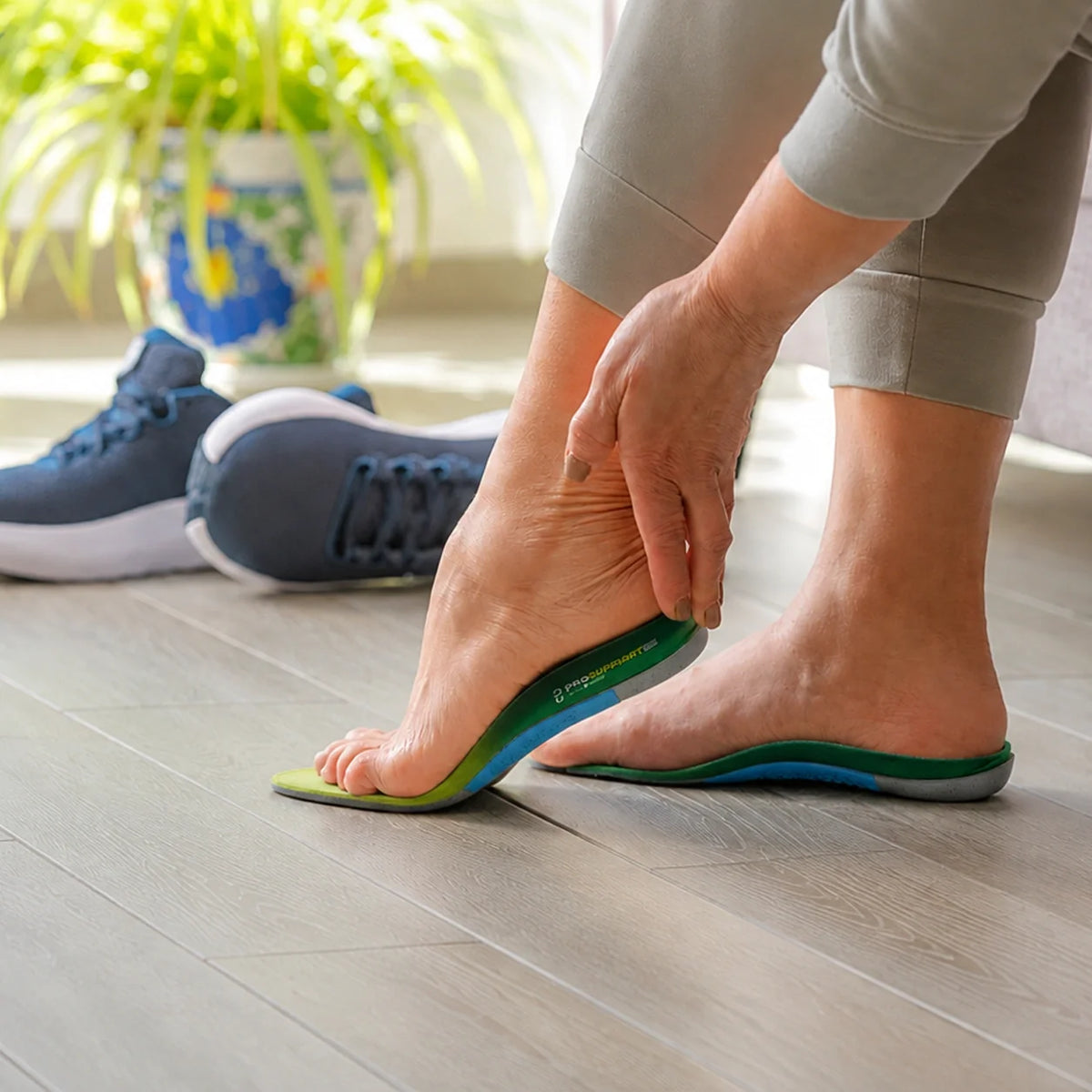
If you are reading this article, you are most likely in the first row. The ProSupport Low Arch was built for exactly that foot: a 7 mm arch shell that lifts a low arch without fighting it, a deep heel cup to stop the inward roll, and Ortholite® open-cell foam on top.
Not sure which row you are? Take the wet test above, then compare your print with the full guide in Arch support insoles: how do they work and why do Indian feet need these?
How the ProSupport Low Arch is designed for Indian feet
Understanding these problems is exactly why we created the ProSupport range. We did not want to sell another cushion. We wanted a real, long-term solution built for the Indian lifestyle.

Here is how the Low Arch insole directly addresses the issues:
Targeted arch support: A 7 mm semi-rigid arch shell provides firm, reliable support to lift a collapsed arch. This helps realign your foot and, by extension, your knees and hips, relieving the chain reaction of pain.
Engineered heel cup: The deep heel cup cradles the heel bone and holds it steady, so the foot stops rolling inward with every step. It also absorbs the shock from hard tiles and concrete.
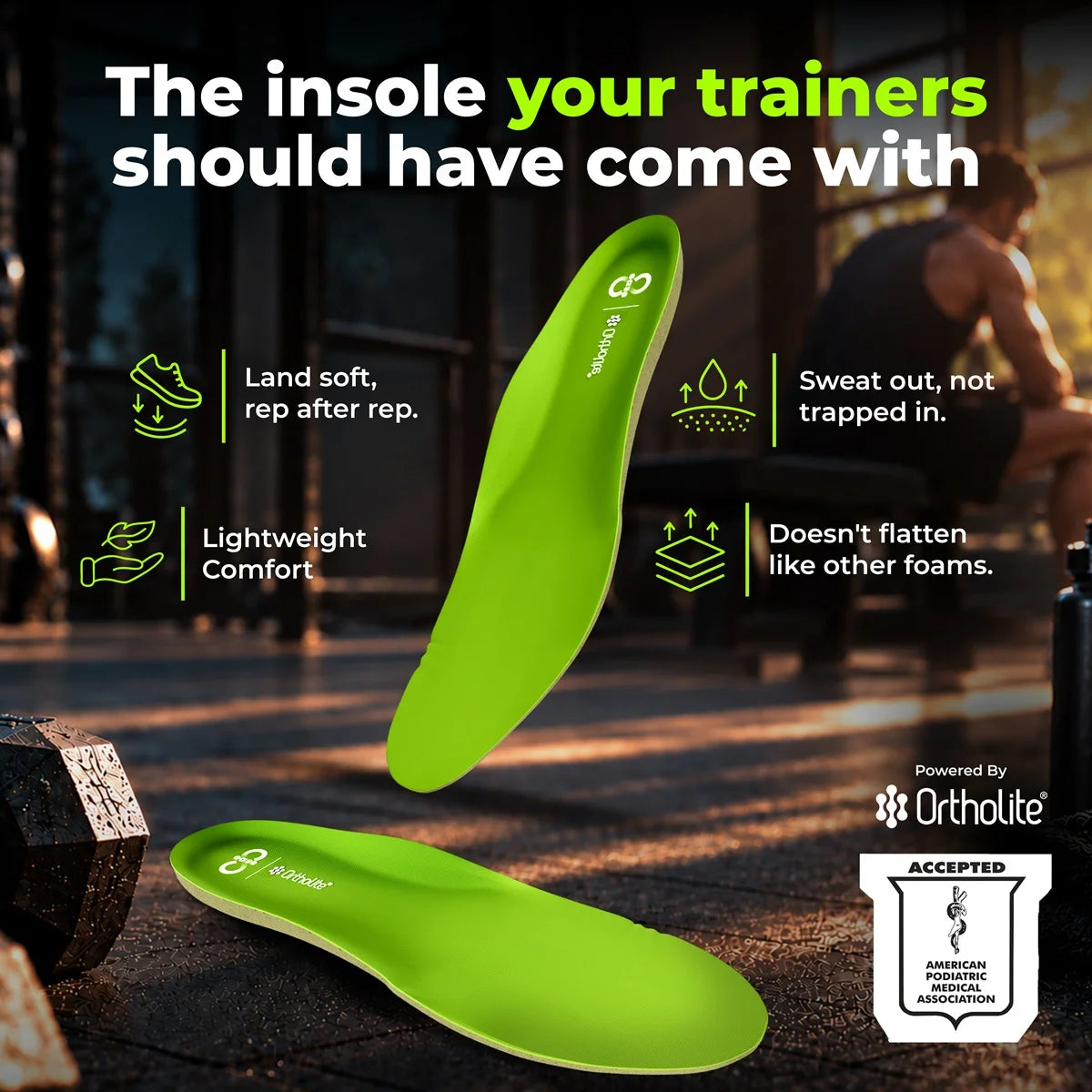
Advanced, global technology: We use Ortholite® open-cell foam, a globally recognised material trusted by over 500 international footwear brands and accepted by the American Podiatric Medical Association. It does not just cushion. It resists compression, meaning it will not flatten out. Your support lasts for 2+ years. Plus, it is moisture-wicking and machine washable, a must-have for Indian weather.
Trim-to-fit: It comes slightly oversized with a cutting guide underneath, so it fits your work shoes, your sneakers and your walking shoes alike. Remove the shoe's original insole first and there is no tightness.
Flat feet in children: when to act and when to wait
If you are a parent reading this because your child's footprint looks flat, take a breath. Almost all children have flat feet when they are small. The arch is still forming, and there is a natural pad of fat under the foot that hides it. For most children the arch appears on its own somewhere between the ages of five and ten.
What to look for is not the flat print itself but how the child walks and feels:
- Complaints of tired or aching feet or legs after school or play
- Avoiding running, or tiring faster than other children
- Shoes wearing down unevenly on the inside edge
- Ankles that look like they roll inward when standing
- A flat foot on one side only, or stiffness in the foot
If you see those signs, especially past the age of six, a visit to a paediatrician or a children's orthopaedic doctor is the right first step. For the everyday case, a tired flat-footed child in school shoes for eight hours a day, a child-sized arch support insole makes a real difference.
8ease Sprouts is built for exactly that: a trimmable children's insole with a gentle arch, an anti-microbial top layer that stays fresh through a school week, and fully washable. At ₹799 a pair, it slips into school shoes and sports shoes alike.
If you mostly wear chappals, sandals or juttis
This is the gap no one talks about. Every article on flat feet assumes you wear closed shoes. In India, for a large part of the year, a lot of us do not.
A full insole cannot go into a sandal. What can is a slim adhesive arch support cushion that sticks to the footbed and gives the arch something to rest on. The 8ease Belle ArchEase Cushions are designed for flats, sandals and heels: a contoured arch pad that stays put, is low enough to be invisible, and costs ₹279. They will not do what a full ProSupport insole does, but they are the difference between a sandal that drains you by evening and one that does not.
Taking the right step
So, the next time you feel that ache in your arch or that tiredness in your knees after a day on your feet, remember that it is not something you just have to tolerate. It is your body telling you it needs better support. Investing in a quality pair of insoles that matches your arch is one of the simplest and most effective decisions you can make for your daily comfort and long-term health. It is about giving your feet the foundation they need to carry you happily through every part of your busy life.
Which 8ease is right for you?
| If this sounds like you | Start with | Price |
|---|---|---|
| Flat or low arch, feet and knees tired by evening | ProSupport Low Arch (7 mm) | ₹849 |
| Medium arch, you want structured everyday support | ProSupport Medium Arch (12 mm) | ₹849 |
| High arch or high instep | ProSupport High Arch (17 mm) | ₹849 |
| Normal arch, just tired feet from long hours | Daily Relief Arch Insole | ₹549 |
| Sharp heel pain in the morning along with the flat feet | Plantar Specialist | ₹1,499 |
| A child with flat feet in school shoes | 8ease Sprouts | ₹799 |
| You live in sandals, flats or juttis | Belle ArchEase Cushions | ₹279 |
Free delivery above ₹599. 15-day easy returns. Ships in 5 to 7 days.
Frequently asked questions
Can insoles cure flat feet?
Insoles do not permanently change your foot's structure, so they do not "cure" flat feet. Instead, they work as a support system. By wearing them, you give the arch the structure it needs, which corrects your alignment and relieves the symptoms. Wear them consistently and the tired-by-evening feeling goes away.
Which arch height should I buy for flat feet?
Low Arch, 7 mm. A flat foot needs lifting gently, not pushed up onto a tall arch. If your wet test shows a clear curve, you have a medium arch and the 12 mm is the one. If you are between the two, start with the Low Arch.
I feel a bit of pressure under my arch with the new insoles. Is that normal?
Yes, it is completely normal. If you have had flat feet for a long time, your foot is not used to being properly supported. We recommend a break-in period: wear them for just 1 to 2 hours on the first day, and gradually increase the time over a week. This gives your feet time to adapt to the new, healthier alignment.
Do flat feet cause knee and back pain?
They can. When the arch collapses the foot rolls inward, which turns the shin and the knee inward with it and tilts the pelvis. Over months that shows up as knee pain or a sore lower back after standing. Supporting the arch is often the first thing a physiotherapist will suggest.
How are 8ease insoles different from cheap ones at the chemist?
Most insoles available locally are simple gel or foam pads that offer temporary cushioning but no real structural support. They flatten quickly and do not correct alignment. 8ease ProSupport insoles are orthotic-grade, designed with biomechanics in mind, and made from durable Ortholite® foam that provides consistent support for years.
Should I wear my insoles in all my shoes?
For the best results, yes. Consistency is key to keeping your feet aligned and pain-free. Our insoles are trim-to-fit and can easily be moved between your different pairs of shoes, from your work shoes to your sneakers. For sandals, use the Belle ArchEase cushion instead.
My child has flat feet. Do they need insoles?
Under about six, usually not. Most children's arches form on their own. If your child is older, complains of tired or aching feet, or tires quickly when running, a children's arch support like Sprouts helps in school shoes. If one foot is flatter than the other, or the foot is stiff or painful, see a paediatrician first.
This article is general information, not medical advice. If foot pain is severe, one-sided, or does not ease with support and rest, or if you are concerned about a child's feet, please see a doctor or physiotherapist.
Related blogs